
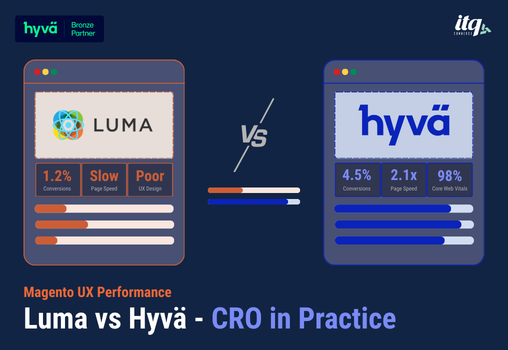
Most Magento merchants don’t lack ideas for improving UX or conversion rates. They lack the ability to execute them.
Buttons feel sluggish. Interactions lag. Mobile journeys carry unnecessary weight. Simple UX improvements take longer than they should or stall entirely. In most cases, the bottleneck isn’t strategy, tooling, or team capability. It’s frontend architecture.
This article examines how Luma and Hyvä differ in terms of Magento UX performance and conversion rate optimisation, and why frontend architecture is increasingly the starting point for meaningful optimisation work.
Magento UX Performance Begins With Speed, Not Design
Good UX is not primarily a design problem. It’s a performance problem.
How a site responds, not how it looks, determines whether users trust it, engage with it, and convert. The key performance factors that shape UX are:
- Page load time across device types and connection speeds
- Interaction responsiveness how quickly UI elements react to input
- Layout stability whether content shifts as the page renders
- Mobile consistency how reliably the experience holds up under real-world conditions
Performance underpins all of these. And that’s precisely where the gap between Luma and Hyvä becomes consequential.
The UX Performance Ceiling of Luma
Luma was not designed for modern UX or performance expectations. It can be styled, extended, and optimised but it carries an architectural ceiling that limits how far those efforts can realistically go.
Interaction Lag and Perceived Slowness
Luma relies heavily on JavaScript-driven rendering. As a result, many interactions feel delayed, depend on background processing completing before responding, and fail to provide immediate visual feedback.
Even when performance metrics appear acceptable, users perceive the friction. And perceived slowness costs conversions, often before any measurement catches it.
Mobile UX Degrades Fastest
Mobile users are less tolerant of latency and more sensitive to interaction delays. On Luma-based stores, this typically manifests as:
- Sluggish category and filter navigation
- Delayed sorting and faceted search responses
- Hesitation during add-to-cart and checkout flows
Mobile now accounts for the majority of ecommerce traffic. Small moments of friction compound quickly and Luma’s architecture makes them difficult to eliminate.
CRO Iteration Becomes Structurally Difficult
When frontend changes are slow to implement and risky to deploy:
- A/B testing becomes expensive and infrequent
- Iteration cycles lengthen
- Teams become reluctant to experiment
CRO shifts from a continuous discipline to an occasional project. That’s not a process failure, it’s a structural one rooted in frontend architecture.

How Hyvä Addresses Magento UX Performance
Hyvä is built on different architectural principles. Rather than layering interactivity on top of a complex JavaScript stack, it prioritises lightweight rendering, reduced dependency overhead, and faster browser execution. The impact on UX performance is direct and measurable.
Faster Feedback Loops Drive Engagement
Hyvä-powered stores feel more responsive because they are. Interactions resolve immediately. Pages render sooner. Layouts remain stable throughout load. From a user’s perspective, the experience reads as:
- More trustworthy
- Easier to navigate
- Less cognitively demanding
These perceptions directly influence purchase behaviour and conversion confidence.
UX Improvements Ship Faster
A simpler, lighter frontend removes the implementation friction that slows CRO work on Luma. Layout changes take less time. UX refinements carry less risk. Iteration cycles shorten considerably.
This enables a healthier, more continuous CRO cadence: test, learn, improve, repeat – rather than batching changes into large, infrequent releases.
Performance Stops Being a Constraint
On Hyvä, teams are no longer constrained by fear of performance regression. Marketers can pursue smarter interactions. Developers can implement UX changes with confidence. CRO ideas that would have been deprioritised on Luma become practical and executable.
The frontend stops being a limiting factor and becomes an enabler.
The Commercial Impact of Magento UX Performance
UX and CRO improvements don’t operate in isolation. They directly influence conversion rate, average order value, bounce rate, and long-term customer confidence.
Faster, more stable experiences reduce friction at every stage of the purchase journey, especially on mobile. Incremental improvements compound over time. The commercial case for resolving Magento UX performance issues is not marginal; for high-traffic stores, it’s significant.
Luma vs Hyvä: CRO Performance in Practice
The difference between these two frontend architectures becomes most apparent when you examine how optimisation actually plays out in day-to-day work.

When UX Ambition Outpaces Frontend Capability
Many Magento teams reach an inflection point where the CRO roadmap is well-defined, UX priorities are clear, and data is available. But execution consistently lags behind intent.
That gap is frequently a frontend architecture problem. Not because Luma is categorically wrong for every use case, but because it wasn’t designed for the UX performance standards or CRO velocity that modern ecommerce requires.
What We Know
Magento UX performance is not just a technical consideration, it’s a commercial one. UX and CRO outcomes are shaped, and often constrained, by the frontend layer they run on.
Luma can support optimisation work up to a point. Hyvä removes many of those constraints at the architectural level. For Magento merchants serious about conversion performance, the difference between the two is not subtle. It’s structural and it compounds over time.