
Luma doesn’t usually fail Magento merchants overnight. Instead, it becomes expensive quietly. Development takes longer than expected. Simple changes turn into tickets. Performance fixes create side effects. Upgrades feel risky.
On the surface, Luma looks like a sensible choice. It’s included with Magento. It’s familiar. It works. But for growing stores, the real cost of Luma isn’t the theme itself. It’s everything that accumulates around it over time.
This article breaks down where that cost actually comes from, and why many Magento teams are rethinking their frontend as a way to regain speed, clarity, and control.
The Myth of the “Free” Frontend
Luma is bundled with Magento, which often creates an early assumption: “We’ll save money by starting with the default theme.”
In practice, Luma is rarely used as-is for long.
As soon as a store needs:
- Brand-led design
- Performance optimisation
- CRO improvements
- Marketing flexibility
…the cost curve starts to climb.
Not because teams are doing anything wrong, but because Luma’s architecture makes everyday work harder than it needs to be.

Where Development Time Really Goes on Luma
Complexity Becomes the Default
Luma’s frontend stack is deeply layered and tightly interconnected, which means that even modest changes require navigating multiple systems at once.
Developers often have to work across Knockout components, UI components, RequireJS dependencies, and template overrides just to implement what appears to be a small change. Each of these touchpoints introduces additional context-switching and risk, making adjustments more fragile than they initially seem.
Over time, this complexity compounds, resulting in longer delivery estimates, slower overall development, and an increased reliance on senior developers to safely make changes.
Small Changes, Big Effort
Tasks that should be quick wins, such as simple layout tweaks, UX improvements, or frontend experiments, frequently expand into multi-day efforts. This isn’t because the ideas themselves are complicated, but because the frontend architecture makes even small changes costly to implement.
As a result, marketing efforts slow down, conversion rate optimisation experiments become harder to run, and time-to-market for new features increases. These delays don’t just affect engineering efficiency; they translate directly into real commercial costs for the business.
Development Effort Comparison

What this means: With Luma, effort compounds. With a lighter frontend, effort scales more predictably.
The Maintenance Tax No One Budgets For
Luma-based builds tend to accumulate frontend technical debt over time. Customisations stack up. Workarounds become permanent. Dependencies multiply.
Then upgrades arrive.
Magento Upgrades and Frontend Risk
Each Magento update introduces uncertainty:
- Will this break a custom override?
- Will performance regress?
- Will a “small fix” unravel something else?
As a result:
- Upgrades are delayed
- Security patches take longer
- Teams become risk-averse
Maintenance stops being routine and starts becoming strategic firefighting.
The Cost of Slow Iteration
One of the least visible, but most damaging, costs of Luma is lost momentum.
When frontend changes are slow:
- UX improvements get deprioritised
- CRO ideas stay theoretical
- Marketing teams self-censor requests
Over time, the store evolves more slowly than the business demands. That gap is expensive.
Not in a single invoice but in:
- Missed conversion uplift
- Delayed improvements
- Reduced experimentation
Why Development Speed Matters More Than Ever
Modern e-commerce isn’t static. The stores that perform best are those that iterate frequently, test ideas quickly, and respond to real data rather than assumptions. This kind of responsiveness depends heavily on frontend speed, which enables teams to experiment, refine, and improve without friction.
When every change feels heavy, teams naturally optimise less. Slow iteration leads directly to slower growth. This is where many Magento merchants realise the problem isn’t a lack of resources, but the limitations of the frontend foundation itself.
Speed & Opportunity Cost Comparison
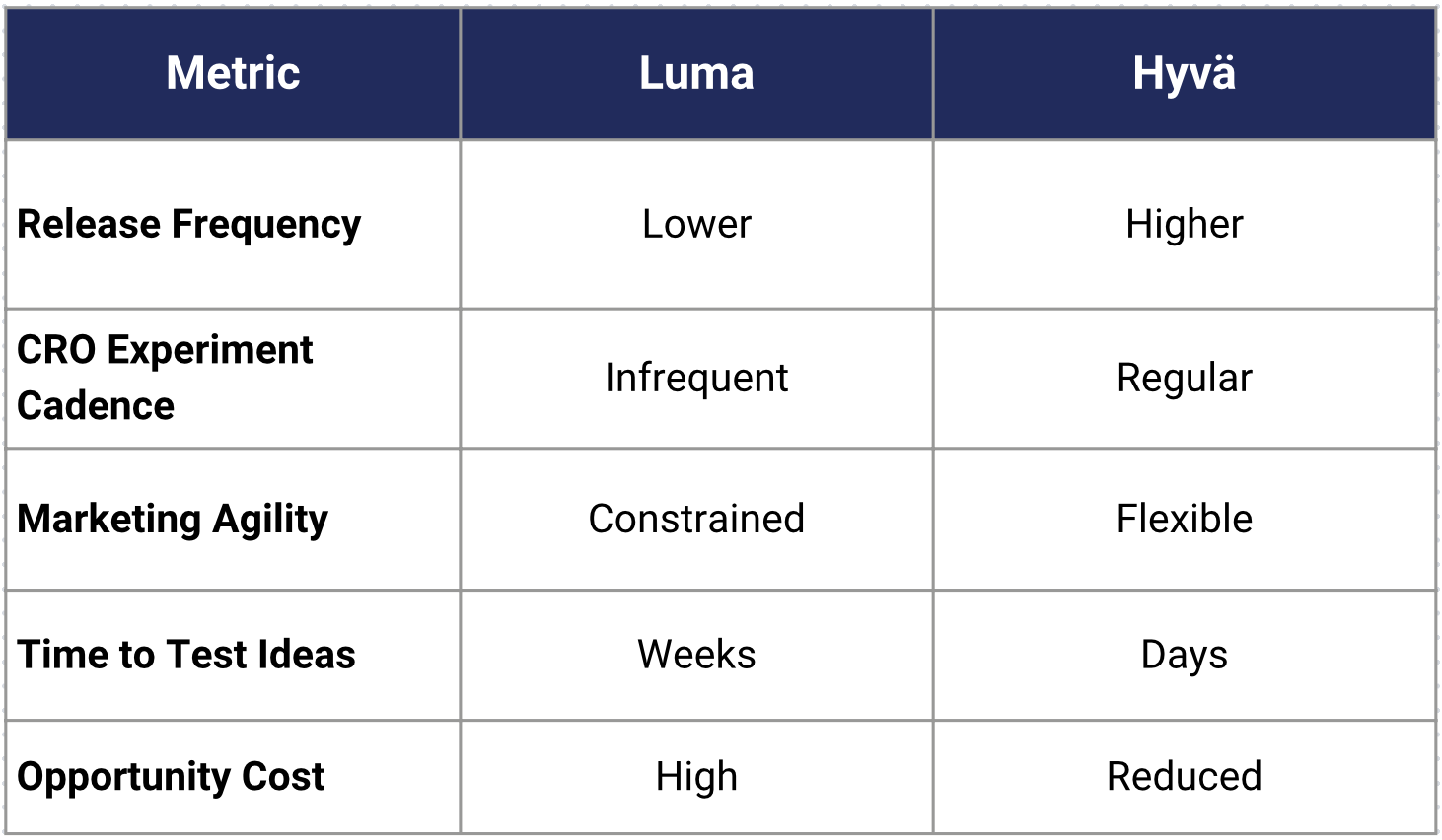
Key insight: Slower iterations don’t just cost time; they present a loss of growth opportunities.
How a Lighter Frontend Changes the Economics
When merchants move away from Luma’s complexity, the difference isn’t just technical. It’s operational.
A simpler frontend:
- Reduces development effort
- Lowers maintenance overhead
- Makes upgrades more predictable
- Unlocks faster experimentation
Instead of spending time working around the frontend, teams can focus on outcomes.
Reframing the Cost Conversation
The question isn’t: “How much does this theme cost?”
It’s: “How much time and opportunity does our frontend consume over a year?”
When merchants step back and look at:
- Development hours
- Release frequency
- Maintenance cycles
- Missed CRO opportunities
…the cost of staying on Luma often outweighs the effort of change.
The Takeaway
Luma isn’t inherently “bad”. But for growing Magento stores, it often becomes expensive in ways that don’t show up on a line item. Slower development. Heavier maintenance. Limited agility.
Those costs compound quietly until progress stalls.
Understanding that dynamic is what leads many teams to reassess their frontend, not as a design decision, but as a strategic lever for growth.