Magento is still one of the most powerful e-commerce platforms on the market. But the frontend you choose can either unlock that power or quietly hold your store back.
For years, Luma has been the default Magento theme. It shipped with the platform, powered thousands of stores, and became the baseline for Magento development.
Today, however, many growing merchants are asking the same question:
Is Luma still fit for purpose or is it time to move to Hyvä?
This article breaks down the real differences between Hyvä and Luma, not just from a technical perspective, but in terms of performance, cost, UX, and long-term scalability. The aim is to help you make the right decision for your business growth plans.
What Is Luma?
Luma is the default frontend theme that comes bundled with Magento Open Source and Adobe Commerce.
It was originally designed to:
- Demonstrate Magento’s frontend capabilities
- Provide a reference architecture for developers
- Act as a starting point for custom themes
For a long time, it did its job well.
But Luma was built for a very different era of e-commerce.
Where Luma Starts to Struggle Today
As Magento stores scale, common Luma-related challenges begin to surface:
- Heavy JavaScript dependencies
- Slower page loads, especially on mobile
- Increasing development complexity
- Difficulty meeting Core Web Vitals targets
- Higher ongoing maintenance costs
Luma still works, but it often works against modern performance, UX, and CRO expectations.

What Is Hyvä?
Hyvä is a modern Magento frontend framework built specifically to solve the problems merchants and developers face with Luma.
Rather than patching over Magento’s frontend complexity, Hyvä takes a fundamentally different approach:
- Minimal JavaScript
- Clean, lightweight templates
- Modern tooling
- Performance-first architecture
Hyvä wasn’t created as a designtrend.
It was created as a response to real-world Magento pain points.
And adoption reflects that: Hyvä has quickly become the go-to frontend choice for performance-focused Magento merchants and agencies.
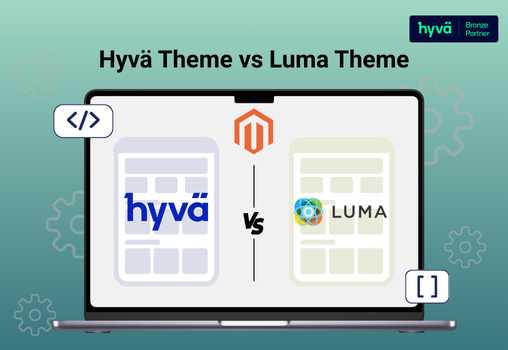
Hyvä vs Luma: Key Differences for Magento Merchants
While both themes technically power Magento stores, the differences become clear when you look at performance, cost, and scalability side by side.
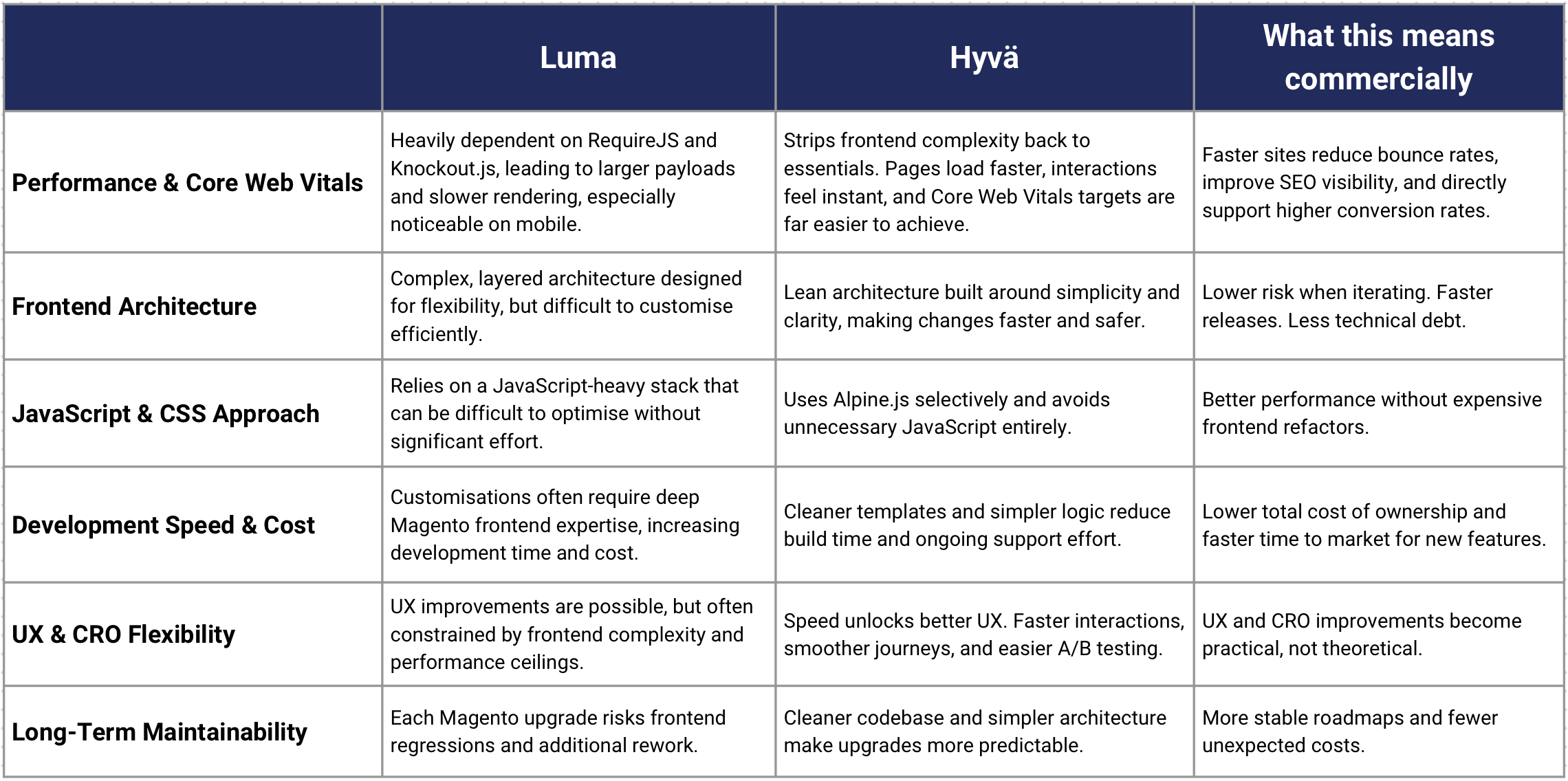
For most growth-focused merchants, this comparison explains why Hyvä is increasingly becoming the default choice over Luma.
The Real Difference: Business Impact, Not Just Technology
On paper, Hyvä is “just” a frontend.
In practice, it changes how Magento stores operate.
Merchants moving away from Luma typically see:
- Faster site speed without heavy optimisation projects
- Reduced development overhead
- More flexibility for marketing and CRO teams
- Stronger SEO foundations
- A frontend that scales with the business, not against it
For example, when ITQ Commerce rebuilt Hedges Direct’s Magento frontend using Hyvä, the focus was on reducing friction during peak seasonal demand: improving speed, UX clarity, and conversion efficiency at scale.
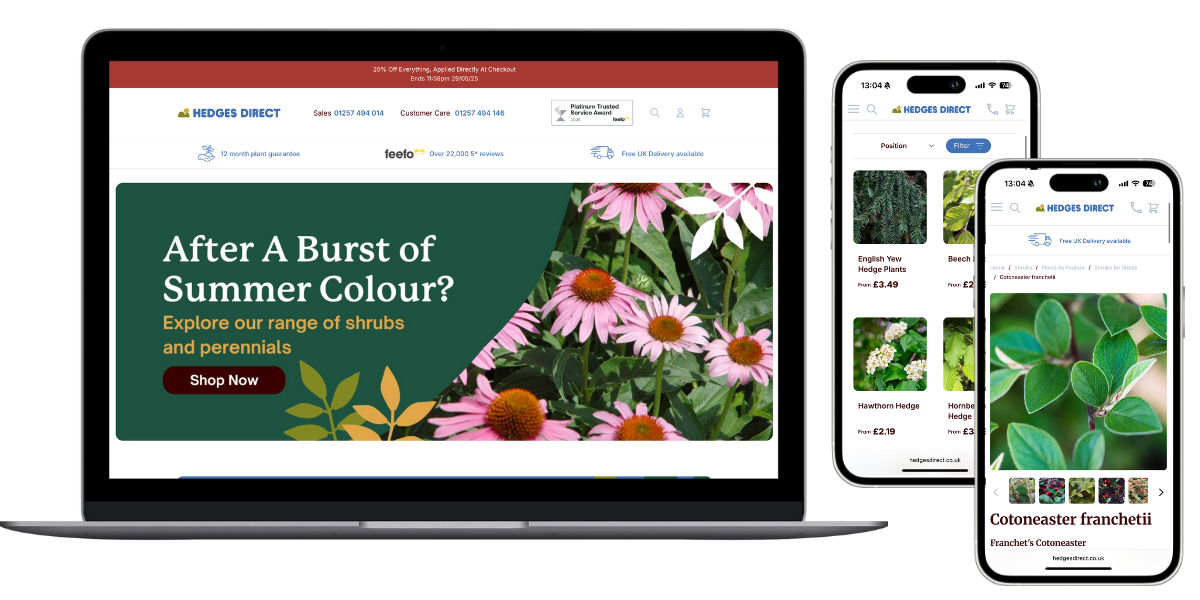
This is why Hyvä is increasingly viewed not as an alternative but as the modern default for Magento growth.
When Might Luma Still Make Sense?
Luma can still be suitable if:
- You’re running a very small catalogue
- Performance is not a priority
- The store is unlikely to evolve significantly
- You’re working with legacy customisations that cannot yet be reworked
For most growth-focused Magento merchants, however, these scenarios are becoming the exception rather than the rule.
Why Growing Magento Stores Are Choosing Hyvä
Magento itself hasn’t lost relevance but expectations have changed.
Customers expect:
- Fast mobile experiences
- Frictionless navigation
- Instant feedback
Search engines expect:
- Strong Core Web Vitals
- Clean frontend delivery
Internal teams expect:
- Faster iteration
- Lower maintenance burden
- Predictable development costs
Hyvä aligns Magento with those expectations, without compromising the platform’s power.
How ITQ Commerce Helps Merchants Move Beyond Luma
At ITQ Commerce, Magento is not just one of many platforms we support, it’s a core specialism.
We work closely with the Hyvä ecosystem and approach frontend rebuilds strategically:
- Performance-first audits
- UX and CRO-led planning
- Minimal disruption to backend logic
- Clear migration and testing processes
Hyvä is not treated as a theme swap, but as a business upgrade.
Is Hyvä Right for Your Magento Store?
If your Magento site feels slower, harder to evolve, or more expensive to maintain than it should be, the frontend is often the root cause.
Hyvä isn’t the right answer for every store but for most merchants serious about performance, UX, and scalability, it’s increasingly the logical next step.
A focused review can quickly determine whether a move away from Luma makes sense for your business.